
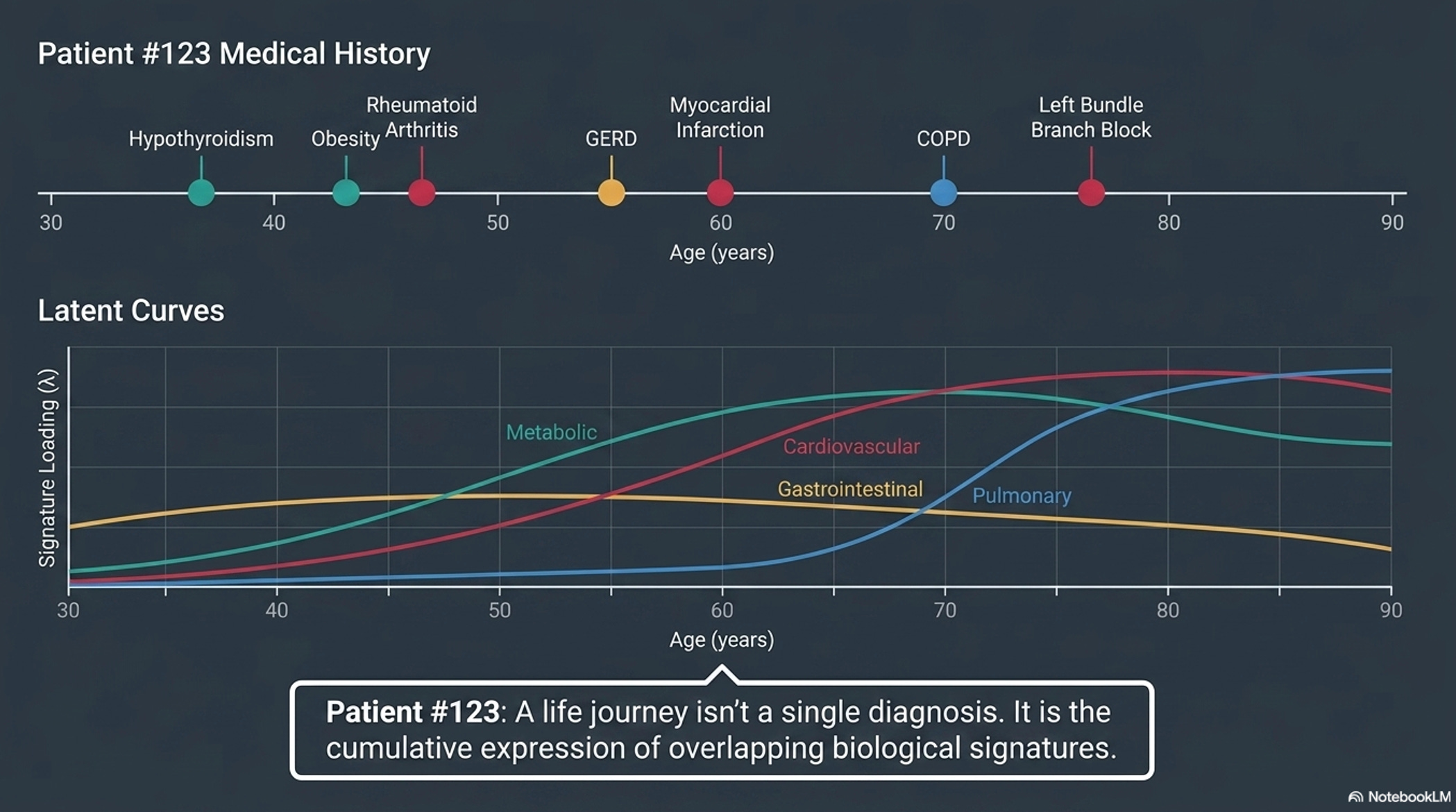
Sarah Urbut is a physician-scientist at Harvard Medical School and the Massachusetts General Research Institute. She and her colleagues published a landmark paper in Nature on patient health journeys for 3 different cohorts—the Mass General Brigham patients, the UK Biobank, and the All of Us research program—with a cumulative 683,000 individuals, 348 diseases, and up to 52 years of follow-up. Integrating electronic medical records and polygenic risk scores (N=36). An AI model was developed and validated called ALADYNOULLI, with each individual represented latent disease signatures (N=21), mathematically and biologically driven. An example of a patient’s dynamic life journey (health arc) is provided in the Figure below (adapted from the paper, made with NotebookLM). The longitudinal story for each individual is key here. Using a Gaussian process, the risk continually shifts like a GPS navigation when you make a wrong turn and you are re-routed. Considerable effort was dedicated to addressing selection bias with inverse probability weighting.
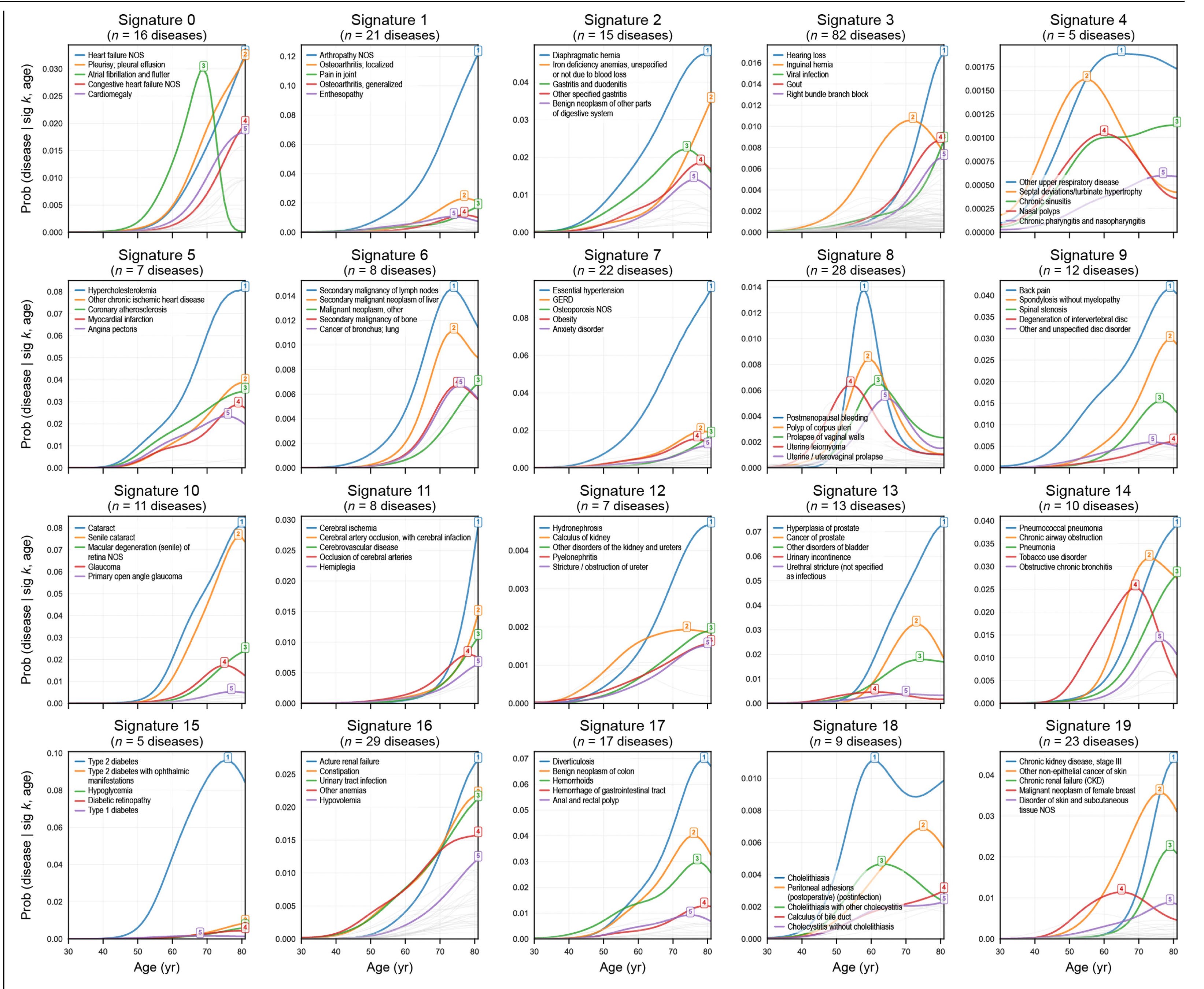
Here are 20 temporal pattern signatures for the UK Biobank cohort, which help to provide the biologic mechanism of a person’s disease, as shown for multiple conditions like heart attack, breast cancer, and depression. That is, the same disease phenotype can link to different genomic pathway underpinnings. An example for breast cancer could be related to signature 8 or signature 7; the latter tied to inflammation and metabolic abnormalities. This biological pattern could also be used to detect likely medication failure (such as SSRI treatment for depression) and predict rare diseases.
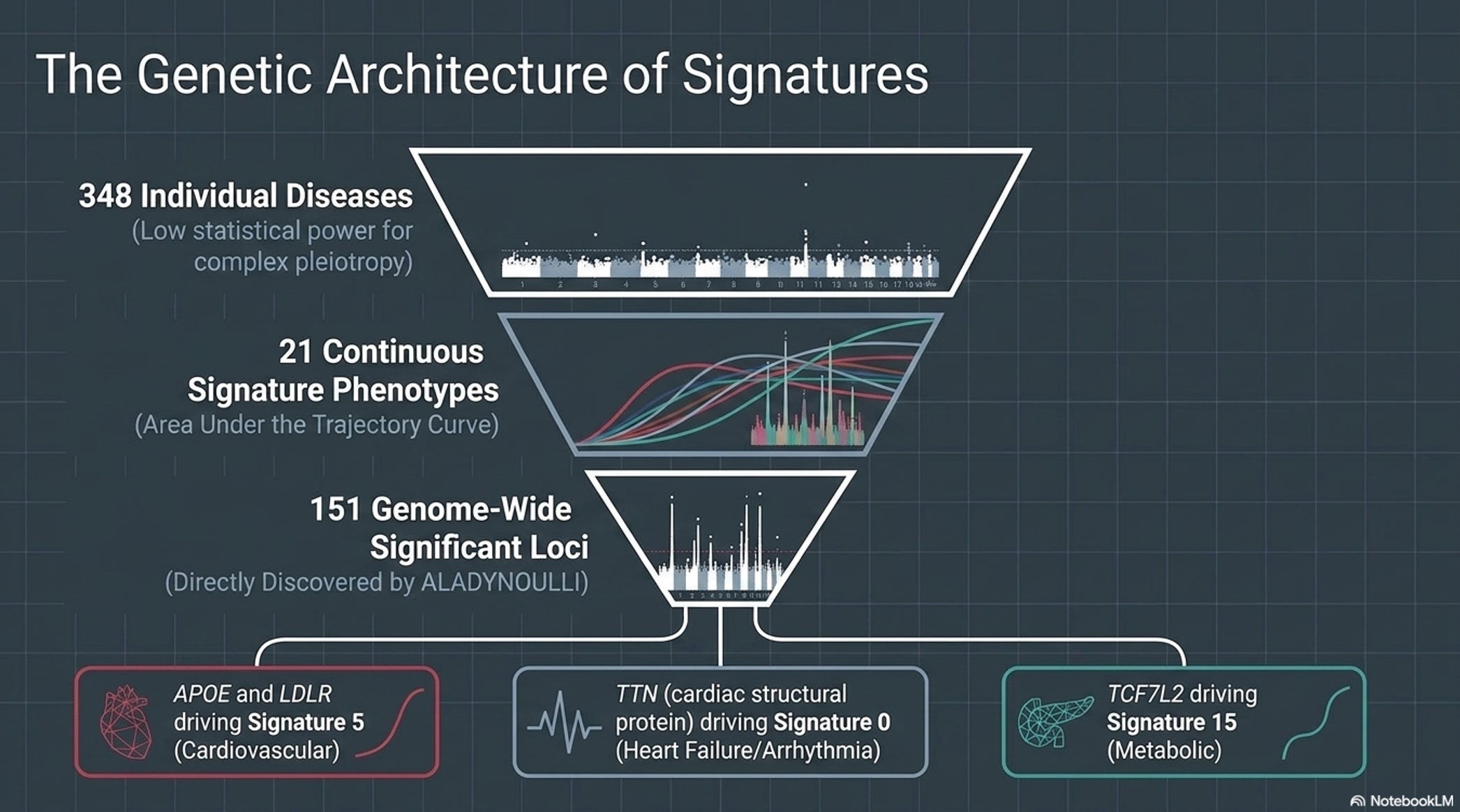
In fact, the model was used to discover genomic signatures for different diseases, as shown below.
This model predicted 1 and 10-year risk of diseases at the individual level and far surpassed routinely used clinical prediction calculators such as the pooled cohort equation (PCE) for coronary artery disease (0.89 vs 0.68, respectively, 1-year risk ) and the GAIL model for breast cancer (0.783 vs 0.54, respectively). ALADYNOULLI also surpassed accuracy for precision when compared with the recent Delphi-2M model that I wrote about here
The ALADYNOULLI paper is packed with information and equations and is not easy to get through without a sophisticated math background. That’s why the summary infographic below (made by Notebook LM) may be helpful to grasp its main findings
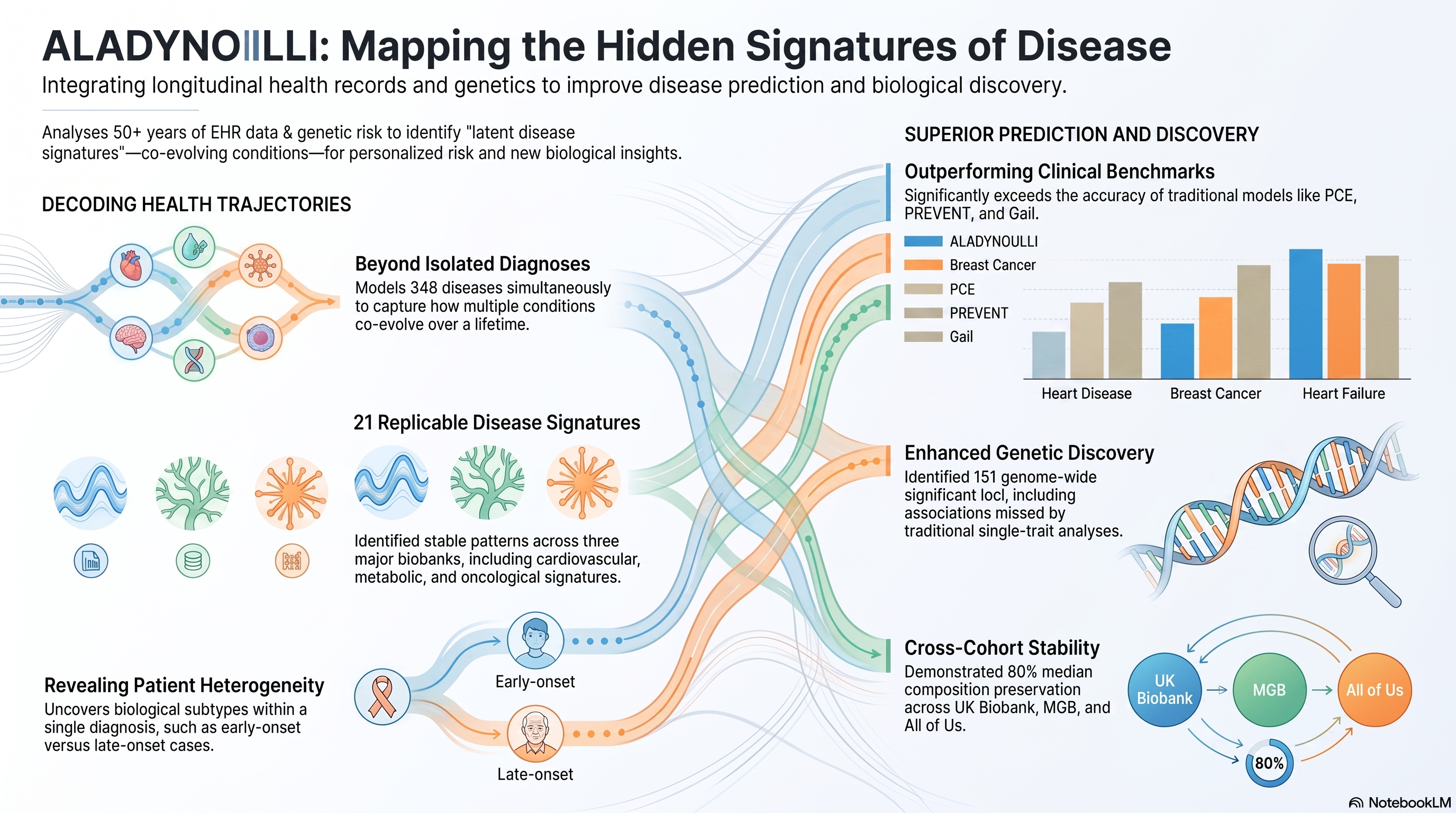
Prediction of Your Health Trajectory in Context
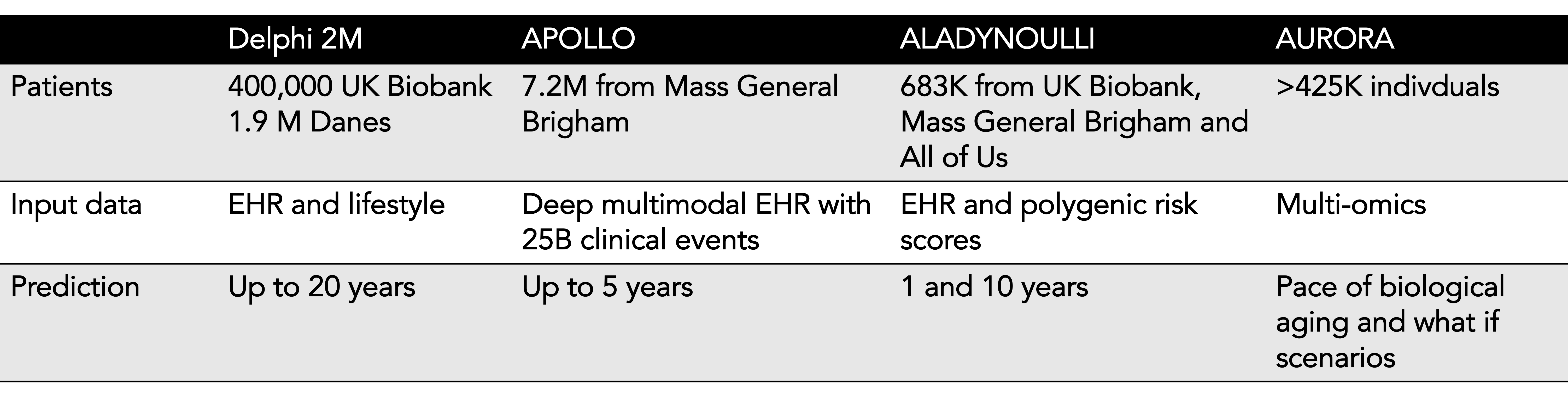
The new model substantively adds to many other recent reports that include Delphi 2M, APOLLO, and AURORA that predict future health events up to 20 years out. Each of these models were different with respect to inputs, how patient data were represented (tokens, embeddings, or latent states), and prediction outputs as briefly summarized in the Table I made below. Notably, the inputs are complementary and likely additive, such that the deeper and longer (longitudinally) the data re for each individual, the better predictive accuracy will be possible.
Adding to these models are many specific disease prediction (e.g. cancer, asthma, diabetes, neurodegenerative diseases) and sources of data (such as sleep lab, wearables, or high-throughput proteomics).
We are now seeing intense efforts at medical forecasting which will continue to evolve and something that was not previously possible in patient care. What I mean is that we could provide a rough sense of a patient’s risk for, let’s say Alzhiemer’s disease, but could not temporally place when it might occur. Age 65 or 95? It makes a huge difference. And so does the ability to apply counterfactuals, what-if scenarios for the individuals to reduce the risk, markedly defer a condition’s appearance, or even fully prevent it. That’s why ALADYNOULLI adds yet another dimension, different methodology, multiple patient cohorts, and novel findings that further add to a new prediction and prevention dimension of medical practice. It couldn’t have been done with multimodal AI.
Note to readers: I wrote this post entirely. There was no AI used except to generate 3 Figures by Notebook LM (Figure 1,3 and 4) as noted. Figure 2 above is from the Supplemental information of the paper. I have no COI related to this post.
******************************
A big thanks to Ground Truths subscribers from every US state and 212 countries. Your subscription to these free essays and podcasts makes my work in putting them together worthwhile. If you’re not a subscriber, please join!
If you found this interesting PLEASE share it!
Paid subscriptions are voluntary and all proceeds from them go to support Scripps Research. They do allow for posting comments and questions, which I do my best to respond to. Please don’t hesitate to post comments and give me feedback. Let me know topics that you would like to see covered.
Many thanks to those who have contributed—they have greatly helped fund our summer internship programs for the past two years. It enabled us to accept and support a record number of 61 summer interns here with us now! These are high school, college and medical students selected from thousands of applicants. We couldn’t do this expanded program without the funds coming in through Ground Truths.
And thank you Harshi Peiris, Ph.D., DOCTOR KLOVER 🍀, William Joseph Turner, Barry R. Davis, Robert Taylor, and hundreds of others for tuning into my live video with Sarah Urbut, MD PhD! Join me for my next live video or newsletter in the app.


